
Should My EV Charger Be Hardwired or Connected Through a NEMA Outlet in Toronto?
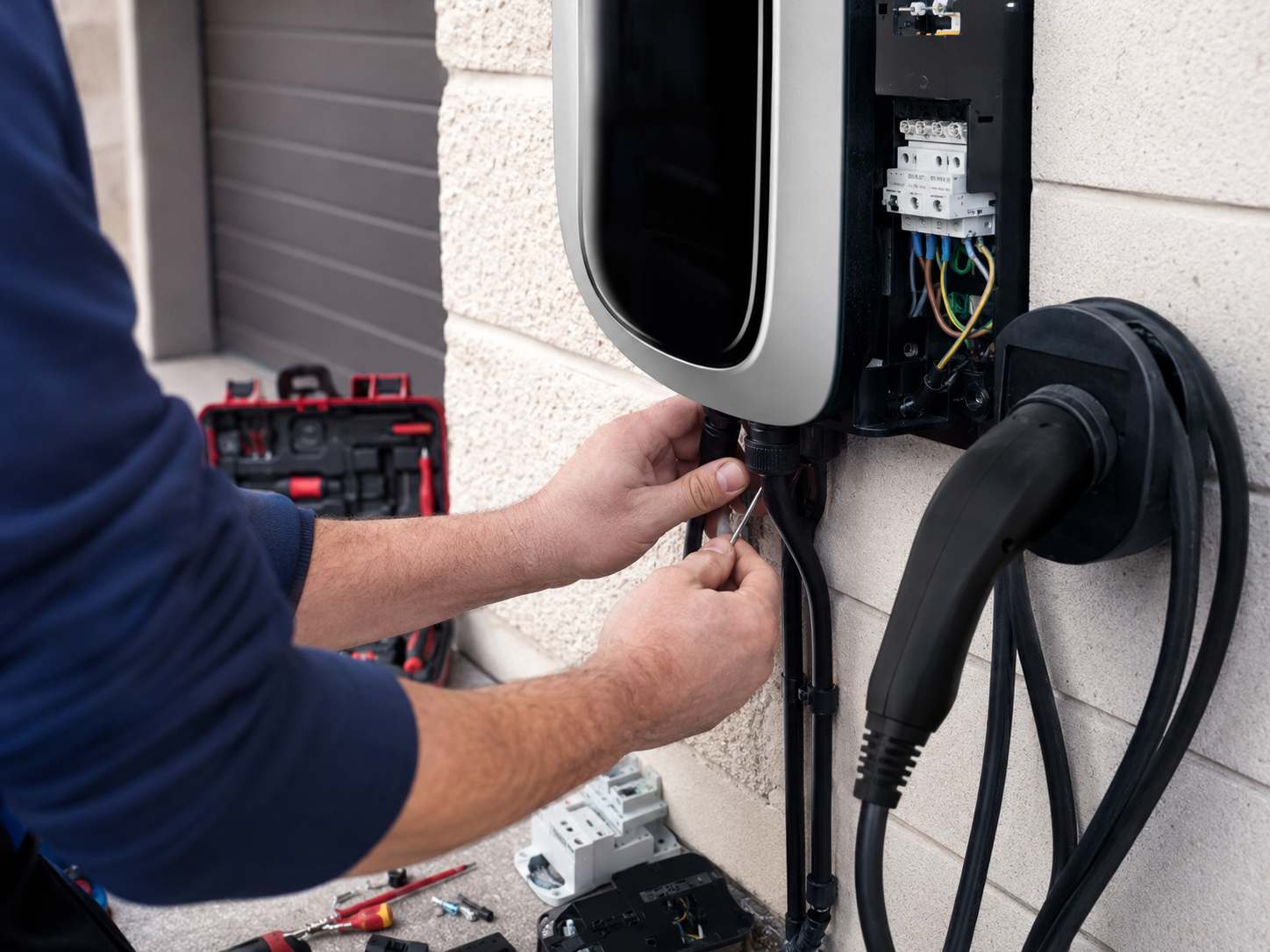
For most Toronto homeowners planning permanent Level 2 charging, hardwiring is often the cleaner long-term solution, while a NEMA receptacle can make sense when portability or easy charger replacement is important.
Neither option is automatically best for every home.
The correct choice depends on the charger, required charging output, where it will be installed and how you expect to use the equipment. When comparing EV Chargers, decide early whether you want a permanent or portable setup so your electrician can design the circuit around the actual equipment.
What Is a Hardwired EV Charger?
A hardwired EV charger is permanently connected to its electrical circuit rather than plugged into a receptacle.
The electrical wiring runs directly to the EVSE.
This creates a fixed installation intended to remain in place.
Hardwired installations are popular when homeowners want a permanent charging station in a garage or driveway and do not expect to move the charger regularly.
What Is a NEMA Outlet Installation?
Some portable or plug-in Level 2 EVSE units connect to a 240-volt receptacle.
A commonly discussed example is a NEMA 14-50 configuration, although the actual receptacle must match the approved charger and installation requirements.
The receptacle is permanently installed, while the charging equipment can be unplugged.
That can be useful if you:
- want to take compatible charging equipment elsewhere;
- expect to replace the unit;
- prefer removable equipment; or
- have a charger specifically designed for plug-in use.
Why Choose Hardwired?
Hardwiring has several practical advantages.
Fewer Connection Points
A hardwired charger does not rely on a plug-and-receptacle connection between the branch circuit and EVSE.
For equipment expected to remain installed for years, that simplicity can be attractive.
Good for Permanent Installations
If the charger will always stay in the same garage, there may be little benefit to adding a receptacle solely so the charger can technically be unplugged.
Suitable for Many Higher-Output Units
Some EVSE models or charging configurations are designed specifically for hardwired installation.
The manufacturer’s instructions and electrical design should determine what is permitted.
Outdoor Applications
Hardwiring can also be a practical approach for permanently installed outdoor charging equipment, provided the equipment is approved for the environment.
ESA requires EV charging equipment used in Ontario to carry an accepted Canadian certification mark or evaluation label.
Why Choose a NEMA Outlet?
A plug-in configuration has its own advantages.
Easier Charger Removal
If the charger fails or you want to replace it, a compatible plug-in EVSE can generally be disconnected without removing permanent wiring from the unit itself.
Portability
Some EV owners want to bring their portable charging equipment to another property.
ESA has discussed portable EVSE installations in which receptacles are provided at multiple locations, distinguishing them from fixed-in-place charging equipment.
Flexibility
A receptacle may provide flexibility when using charging equipment specifically approved for cord-and-plug connection.
However, that does not mean any 240-volt receptacle can automatically be used for any EV charger.
Is a NEMA Outlet Cheaper?
Not always.
Homeowners sometimes assume that installing an outlet must be simpler than hardwiring.
But the circuit still needs to be designed for EV charging and comply with the current Ontario Electrical Safety Code.
Depending on the equipment and location, a receptacle installation can introduce its own equipment and protection requirements.
The better decision should therefore be based on the charger and intended use rather than assuming an outlet is automatically the budget option.
Can I Install a 14-50 Outlet and Decide on the Charger Later?
It is usually better to choose the charger—or at least narrow down your options—before the electrical design is finalized.
Different chargers can have different:
- input requirements;
- maximum charging currents;
- installation methods;
- plug configurations; and
- manufacturer instructions.
ESA emphasizes that EV charging equipment must be approved for use in Ontario.
Your contractor should therefore design the circuit around equipment that is actually suitable for the proposed installation.
What About Adjustable-Amperage Chargers?
Some fixed-in-place EVSE allows the installer to commission the unit at a lower output than its maximum nameplate capability.
ESA has explained that approved adjustable settings can be used for circuit and service sizing when applicable conditions are satisfied and access to those settings is appropriately restricted.
Importantly, ESA distinguishes fixed-in-place charging equipment from portable plug-in equipment for these purposes.
That distinction can influence whether hardwired or plug-in equipment makes sense for a particular installation.
Which Option Is Better for Outdoor Charging?
For an outdoor installation, durability and equipment ratings matter.
The charger, receptacle if applicable, enclosures and other electrical components need to be suitable for the environment.
Toronto weather exposes equipment to snow, moisture, freezing temperatures and seasonal temperature swings.
A Licensed Electrical Contractor can evaluate whether a permanent hardwired installation or approved receptacle-based arrangement is more appropriate for that location.
Does Either Option Avoid the ESA Permit?
No.
Choosing a plug-in charger does not eliminate the ESA requirements associated with installing new electrical infrastructure.
ESA states that all EV charger installations require an electrical Notification of Work before installation begins, and hired electrical work must be completed by a Licensed Electrical Contractor.
So Which Should I Choose?
Choose hardwired when:
- the charger will be permanent;
- you do not need portability;
- the charger is designed or required to be hardwired;
- you want a clean fixed installation; or
- the electrical design favours that approach.
Consider a receptacle-based installation when:
- your approved EVSE is designed for plug-in use;
- portability matters;
- you expect to remove the charger regularly; or
- flexibility is a major priority.
Final Answer
For many Toronto homeowners, hardwiring is an excellent choice for a permanent Level 2 charging station, while a properly designed NEMA receptacle installation is useful when removable or portable charging equipment is genuinely desired.
Do not choose solely based on which option appears cheaper.
The charger model, electrical capacity, installation location, charging output and current Ontario requirements should determine the final design.